
The link between music, maths and creativity
The link between Einstein and Coltrane
I started this series of essays on creativity with some thoughts inspired by Quincy Jones’ book “12 Notes: On Life and Creativity.”
In the introduction Quincey Jones says the number 12 has always had a special meaning in his life. His former music teacher explained that every musician from Bach to Bo Diddley works with the same 12 notes and she wanted him to learn what everybody did with them.
His own creations show how many unique sounds can be made from those same 12 notes and a combination of rhythm, harmony and melody.
In my business world I’ve always been fascinated by how many computer scientists, games developers and others who are familiar with creating in code are also accomplished musicians.
There’s obviously a link between maths and music.
Digging into this I found that Pythagoras discovered that different weights and vibrations make different sounds. The pitch of a vibrating string is directly proportional to its length. If you cut the string in half, the pitch will be one octave higher than the original.
I went down several rabbit holes exploring the links between creativity, music and maths … There is even a special academic publication dealing with the subject, the Journal of Mathematics and the Arts.
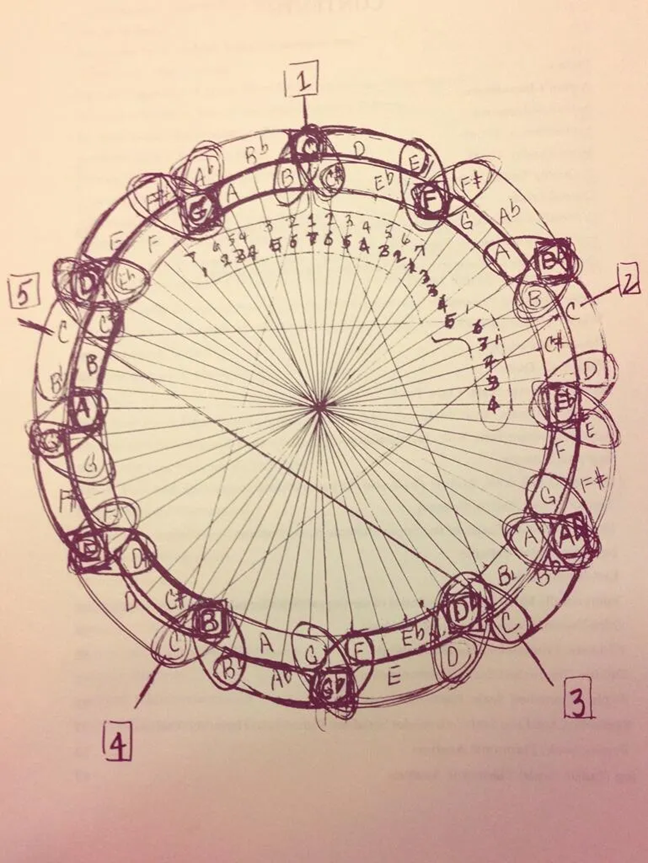
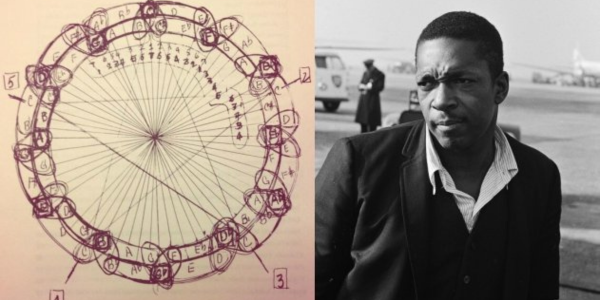
In 1967 John Coltrane drew the “Coltrane circle,” which resembles what any musician will recognize as the “Circle of Fifths,” but incorporates Coltrane’s own innovations.
Dartmouth professor and astrophysicist Stephon Alexander says this changed his whole research direction and led to a discovery in physics. It turns out both Einstein and Coltrane saw music and physics as intuitive, improvisatory pursuits. Coltrane “was a musical innovator, with physics at his fingertips,” and “Einstein was an innovator in physics, with music at his fingertips.”
That’s probably the deepest rabbit hole into creativity I’ve been down so far …
What do you think? Are you a musician as well as a tech nerd? Does this resonate with you?
This is part of a series of posts on Questions about Creativity. The rest of the series can be seen at: https://annhawkins.com/creativity